Kolkata Street Food Loses Its Morning Price by 11 AM
Kolkata's street food is legendary, but the conventional travel coverage misses a crucial detail: the price you see at 9 AM is not the price you pay at noon. By 11 AM, many vendors slash their rates by half, and the unwary tourist who strolls up at lunchtime often gets charged double what a local paid just hours earlier. This isn't a secret — it's a system, and once you understand it, you can eat better for less.
The Myth of the All-Day Bargain
Most guidebooks present Kolkata street food as uniformly cheap. They list a kathi roll at ₹60 or a plate of puchka at ₹30, as if those prices hold all day. They don't. As of late 2024, the morning window from 7 to 9 AM is when vendors set their base prices — the rates that regulars, mostly office workers and early shoppers, are willing to pay. By 10 AM, as the breakfast rush fades and the lunch crowd hasn't yet arrived, prices begin to drift.
At one well-known stall near College Street, a plate of puchka that costs ₹30 at 8 AM is offered at ₹20 by 11:30 AM. The vendor isn't being generous; he's trying to move the batch before the afternoon heat turns the tamarind water sour. The same logic applies to kathi rolls, chow mein, and even sweets. The price chart is effectively an hourly curve: steep drop around 11 AM, a slight rebound during the lunch peak (noon to 1:30 PM), then another dip after 3 PM.
Tourists who arrive after 10 AM often pay the "visible foreigner" markup — sometimes 50% above the morning rate. Locals, of course, know the window. A regular customer who works near Shyambazar, a man named Ramesh who commutes daily from Dum Dum, told me, "If I'm not there by 8:30, I wait until 11. Why pay more for the same thing?" The trick is to adjust your schedule, not your expectations.
But there's a catch: the morning batch is usually fresher. The potatoes for puchka are boiled that morning; the batter for rolls is mixed fresh. By late morning, you're getting the leftovers. So the bargain comes with a trade-off in quality. The question is whether you value the savings more than the peak texture.
Why Open Kitchens Lie to You
Travel blogs love to praise "open kitchens" as a sign of transparency. In Kolkata, an open kitchen — a cart where you can see the frying — can be deceptive. Visible frying doesn't mean the oil is fresh. Many vendors reuse oil for days, topping it up with fresh oil only when the level drops. The oil darkens, and with it the flavor of the food.
One cue locals actually use: look for a wet cloth covering the cutting board. If the cloth is clean and damp, it means the vendor wipes the board between items. If it's dry or absent, the board likely hasn't been cleaned since the morning rush. Another sign is the color of the chutney. Fresh tamarind chutney is deep brown with a slight sheen. If it's pale or has floating particles, it's been sitting out for hours.
Metal utensils are another good sign. Plastic or wooden spoons can harbor bacteria in cracks; metal is easier to sanitize. A vendor who uses metal tongs to handle food rather than bare hands is probably more conscientious about hygiene. That said, gloves are not a reliable indicator — they often go unwashed between tasks, used to handle money and food interchangeably.
The most telling cue is the condition of the batter for rolls or fritters. If it's thick and lumpy, it's from yesterday. Fresh batter should be smooth and flow slowly off a spoon. One vendor near Hatibagan, an elderly man named Abdul who has run his stall for 22 years, told me, "If the batter sits more than four hours, it ferments. You can smell it, but tourists don't know the smell." He was right. The sour note is subtle, but once you learn it, you'll notice it.
The Currency Trap at Every Stall
Kolkata street vendors operate almost entirely in cash, and the shortage of small change is a constant headache. By 10 AM, most vendors have run out of ₹10 and ₹20 notes. A tourist who hands over a ₹500 note for a ₹30 plate of puchka is often told, "No change," and expected to either pay more or walk away. This isn't always a scam — many vendors genuinely lack change — but it forces you to overpay.
The solution is to carry a stash of small notes: at least ₹100 in ₹10 notes and a few ₹20 and ₹50 notes. Coins are even better, but increasingly rare. Some vendors now accept UPI (digital payments via QR code), but the QR codes are often fake — printed on paper and pasted over the original, directing payments to a different account. A digital payments consultant named Priya, who works with small businesses in the area, warned me: "If the QR code is on a sticker that looks like it could be peeled off, don't use it. The real one is usually laminated or painted on the cart."
Digital wallets like Paytm and Google Pay work in clusters — around College Street and Park Street, almost every stall accepts them. But in less touristy areas like Shyambazar, cash is still king. The safest strategy is to pay with small notes for small purchases and reserve larger notes for bigger transactions where change is more likely.
There's also a cultural dimension: vendors prefer to keep their cash float high early in the day. Handing them a small note is a courtesy that often earns a smile and a slightly larger portion. It's not bribery; it's just easing their day.
Kathi Roll as a Price Signal
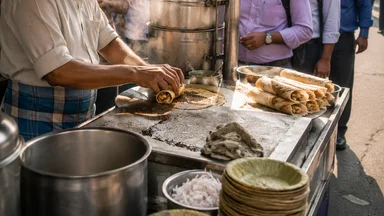
The humble kathi roll — a paratha wrapped around spiced meat or vegetables — is the best price barometer in Kolkata. A standard egg roll at a reputable stall near Nizam's (the legendary restaurant in New Market) costs roughly ₹60 at 9 AM and holds steady until 2 PM. But at smaller carts in tourist-heavy zones like Esplanade, the same roll might be ₹80 at noon, dropping to ₹50 by 3 PM. The markup reveals the tourist zone.
Local hack: watch the filling ratio. At morning stalls, the roll is generously stuffed — the paratha is just a wrapper. By late morning, the filling shrinks, and the paratha thickens. One vendor near College Street, a young man named Subir who took over his father's cart five years ago, admitted, "After 11, I use less mutton. The tourists don't notice because they don't know the usual amount." He was matter-of-fact, not apologetic.
Nizam's stall, a landmark since the 1930s, holds its price steady until 2 PM, then reduces by ₹10 for the evening rush. Their rolls are consistently sized, and the filling ratio stays constant. This consistency is why locals queue there even when cheaper options are nearby. The trade-off is that you pay a premium for reliability.
Another signal: the color of the egg. Fresh egg rolls have a bright yellow egg layer; if it's pale or brownish, the egg was cooked earlier and reheated. The best rolls are made to order, not pre-assembled. A vendor who asks "kati?" (meaning "cut" or "how many?") and then starts cooking is a good sign. One who points to a pile of ready-made rolls is cutting corners.
The Puchka Water Test Locals Use
Puchka — crisp fried balls filled with spiced potato and tamarind water — is Kolkata's iconic street snack, but its hygiene is notoriously variable. Locals use a simple water test: they check the tamarind water for floating specks. Fresh tamarind water is clear, with a deep reddish-brown hue. If it looks cloudy or has bits floating in it, the water has been sitting out and may be contaminated.
Another test: the puri (the fried shell) should crack audibly when bitten. A stale puri goes soft and chewy within minutes of being filled. A vendor who pre-fills puris and stacks them is serving old ones. The best puchka is made one at a time: the puri is cracked, filled with potato, dipped, and served immediately. The sound is unmistakable.
The potato mash should be at room temperature, not cold from refrigeration. Cold mash suggests the vendor made a large batch hours ago and stored it. Fresh mash is slightly warm and has a coarse texture. Spice mix is another clue: it should be a deep red, not orange. Orange color indicates old spices or too much chili powder as a preservative.
Finally, ask the vendor to serve the puchka in a leaf bowl (made from sal leaves) rather than a plastic plate. Leaf bowls are biodegradable and less likely to have been reused. If the vendor doesn't offer leaf bowls, it might be a sign of cost-cutting that extends to ingredients. One vendor in Hatibagan, a woman named Shabana who inherited the stall from her mother, told me, "Leaf bowls cost more, but they keep the puchka dry. Plastic makes it soggy." She charges ₹5 extra for leaf bowls; locals pay it.
Three Streets That Keep Their Morning Price
Not every street in Kolkata participates in the price drop game. Three areas in particular resist the pattern, and understanding why helps you plan where to eat.
College Street is the first. The vendors here cater to students and professors from the nearby university, a crowd that is price-sensitive but also consistent. A roll that costs ₹50 at 9 AM will still be ₹50 at noon. The vendors know their regulars, and they'd rather lose a few sales than alienate the base. The trade-off is that the selection is narrower — mostly rolls and puchka, less variety than elsewhere.
Shyambazar five-point crossing is the second. This chaotic intersection sees a steady flow of office workers all day, so the demand curve is flatter. Prices hold until about 1 PM, then drop slightly for the afternoon lull. The anchor stall here — a famous puchka vendor called "Bhola's Puchka" who has been operating for 40 years — never drops prices. "My customers know the quality," says the owner, Bhola Nath. "If I lower the price, they'll wonder what's wrong."
Hatibagan lane, a narrow alley behind the market, is the third. The stalls here are hidden from tourist traffic, and the local clientele is fiercely loyal. Prices stay stable until noon, then drop by only 10–20%. The best strategy is to follow the office-worker breakfast crowd: if you see a queue of men in white shirts and trousers, join it. They know where the morning price still holds.
These three areas prove that the price drop is not universal. It's a function of tourist density and vendor competition. The more tourists a street sees, the more aggressive the price cutting — and the more likely you are to pay a hidden markup earlier in the day.
What Travel Blogs Get Wrong About Hygiene
Most travel blogs offer generic hygiene advice: "Look for busy stalls," "check if the vendor wears gloves," "avoid raw vegetables." In Kolkata, this advice is often misleading. A busy stall can still use stale oil; gloves are often a prop; and raw vegetables, if properly washed, can be safer than cooked food that has been sitting out.
The real risks are less obvious. Ice cubes, for example, are almost always made from tap water. Vendors buy them in blocks from local ice factories, and the water quality varies. If you're having a cold drink, ask for it without ice or bring your own bottled water. Lemon wedges, another common garnish, sit uncovered for hours and collect flies. A vendor who keeps lemons in a covered container is rare but worth noting.
Carts with umbrellas may seem like they protect the food from the sun, but they actually trap heat and create a humid microclimate that accelerates spoilage. A cart without an umbrella, exposed to direct sunlight, forces the vendor to rotate stock faster — which can mean fresher food. It's counterintuitive, but ask any local: the best puchka often comes from a cart with no shade.
Cutting boards are rarely changed between items. A board used to chop raw chicken is often the same one used to slice vegetables for a roll. The only defense is to watch the vendor and, if you see cross-contamination, walk away. One vendor near Park Street, a man named Farhan who runs a popular egg roll cart, told me, "I have three boards — one for meat, one for veg, one for eggs. But I'm the exception." He was right to boast.
Ultimately, the best hygiene cue is your own observation. Spend five minutes watching a stall before ordering. Note how the vendor handles money, whether they wipe surfaces, and how they store ingredients. If they seem rushed or careless, trust your gut. The trade-off between price and quality is real: a lower price at 11 AM may come with older ingredients, and a higher price at 9 AM may buy you peak freshness. Deciding which matters more to you is part of the experience. The savvy traveler learns to balance both, adjusting their schedule and expectations to match the street's rhythms. In the end, Kolkata's street food rewards those who pay attention — not just to the price, but to the entire scene.