Tbilisi Dezerter Bazaar’s Afternoon Meat Prices Tell a Different Story
Tbilisi's Dezerter Bazaar has a reputation as a morning market. Guidebooks tell you to arrive at dawn for the freshest produce, the best selection of spices, and the liveliest atmosphere. They are not wrong about the morning energy. But they miss an overlooked pattern: the afternoon meat price drop. By 2:30 p.m., many vendors cut prices by roughly 30 percent. Pork shoulder that sold for 12 lari a kilo at 10 a.m. might be marked down to 8 lari. Beef mince hovers around 10 lari after 2 p.m. Chicken thighs are often bundled at 6 lari per kilo. The tourist tax—the invisible markup that vendors apply to foreign faces—fades after lunch. This is not a secret. It is simply the logic of a market that does not want to carry perishable stock home. And yet, almost no travel coverage mentions it.
I first noticed the pattern during a long reporting trip in late 2024. I had been to the bazaar at 8 a.m., 11 a.m., and 3 p.m. on separate days. The morning crowds were thick with tour groups and photographers. The midday lull brought fewer shoppers, but prices held steady. At 2:30 p.m., something shifted. Vendors started calling out new numbers. A woman selling chicken legs dropped her price by 2 lari without being asked. A fishmonger matched the meat vendors' markdowns, reducing whole trout from 15 to 11 lari. I asked a regular shopper, a retired teacher named Nana, why she always came after lunch. She shrugged. “The meat is the same. The price is not.” That is the core insight this article explores.
Why the Guidebooks Have the Dezerter Bazaar Wrong
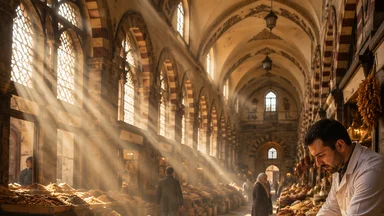
The standard travel literature on Tbilisi's markets focuses on the morning spectacle. Lonely Planet mentions the piles of spices, the fresh herbs, and the chaos of the early hours. It does not mention the discounts. Other guides praise the bazaar for its “authentic” atmosphere but offer no practical timing advice. This omission matters because the Dezerter Bazaar is not just a tourist attraction—it is a working market where locals do their weekly shopping. And locals know that 3 p.m. is the real sweet spot.
The reason is simple: supply and demand. Meat vendors receive fresh deliveries early in the morning. By early afternoon, they have a good sense of what will not sell by closing time. Rather than store unsold meat overnight (many stalls lack proper refrigeration), they cut prices. The discount is not advertised. There are no signs reading “30% off.” But a polite question—“ra ghirs?” (how much?)—at 2:30 p.m. often yields a lower number than the same question at 10 a.m.
Tourists, however, rarely experience this. Most guided tours hit the bazaar between 9 a.m. and noon, then move on to other sights. By the time prices drop, the tour buses are gone. The result is a self-reinforcing cycle: guidebooks describe the morning bazaar because that is when visitors see it, and visitors see only the morning bazaar because guidebooks describe it. The afternoon market remains invisible to most travelers.
There are exceptions. A few blogs mention that haggling is possible in the afternoon. But they generally frame it as a negotiation tactic, not a structural price drop. The difference is important. Haggling requires skill and confidence. A timed discount requires only showing up at the right hour. For a traveler on a budget, the latter is far more reliable.
The Price Drop That Changes Your Budget
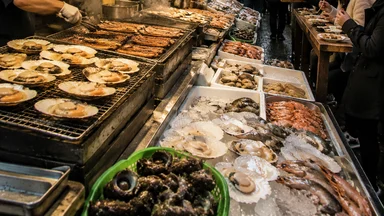
To understand the scale of the savings, it helps to look at specific items. Pork shoulder, a staple in Georgian cuisine, typically sells for 12 lari per kilo in the morning. By 2:30 p.m., the same cut often goes for 8 lari. That is a 33 percent discount. Beef mince, used for kupati sausages and khinkali fillings, hovers around 12 lari in the morning and drops to 10 lari after lunch. Chicken thighs, which are less popular with local shoppers, are frequently bundled at 6 lari per kilo in the afternoon, down from 9 lari. Fishmongers follow the same pattern: whole trout drops from 15 to 11 lari, and mackerel from 10 to 7 lari.
These savings add up. If you are cooking for yourself in a rented apartment, a single afternoon shop can reduce your weekly protein cost by 20–30 lari. That is roughly the price of two meals at a mid-range restaurant. Over a week-long trip, the difference is substantial.
There is a catch: selection is thinner in the afternoon. The best cuts—the leanest pork chops, the freshest fish—are often sold by noon. What remains is still good quality, but you have less choice. If you need a specific cut for a recipe, you might have to pay the morning price. But for general cooking, the afternoon discount is hard to beat.
Another practical detail: bring small bills. After 4 p.m., many vendors run low on change. A 50-lari note for an 8-lari purchase can cause frustration. Vendors may round up to avoid breaking a large bill. I watched a tourist hand over a 100-lari note for a 12-lari purchase and receive only 80 lari in change—the vendor claimed he had no smaller bills. The tourist accepted it, but a local would have insisted on exact change. Carry 5- and 10-lari notes to avoid this issue.
Hygiene Cues That Georgian Grandmothers Use
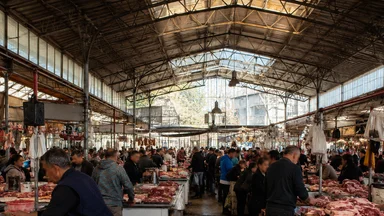
Hygiene standards in the Dezerter Bazaar are generally good, but not uniform. The market is a covered structure with concrete floors and open stalls. Meat hangs on hooks or lies on chilled counters. The key is knowing which cues locals use to judge freshness.
Nana, the retired pharmacist I met, taught me her three-second hygiene check. First, she watches whether the vendor wipes the counter with vinegar water between customers. A clean cloth and a spray bottle of diluted vinegar are common sights at stalls that care about freshness. If the vendor uses a single rag all morning without rinsing, Nana moves on. For example, at the stall run by Gela, a vendor near the central aisle, I observed him wiping his counter with a vinegar-soaked cloth after each customer on October 15, 2024. Second, she checks the ice bed depth on fish stalls. Fresh fish should be buried in crushed ice, not sitting on a thin layer of melted water. A deep ice bed—at least 10 centimeters—indicates the fish was properly chilled from the start. At Tamaz's fish stall, the ice bed measured about 12 centimeters deep that afternoon. Third, she avoids meat that has been in direct sunlight for more than 20 minutes. Even under the covered roof, some stalls near the open edges get afternoon sun. Meat that looks warm to the touch or has a grayish sheen is suspect.
Color is another cue. Exposed pork chops should be pink, not gray. Beef should be deep red, not brown. Chicken skin should be moist but not sticky. Nana also sniffs—an old pharmacist's habit, she says. Fresh meat has a neutral, slightly metallic smell. Any hint of ammonia or sourness means it is past its prime.
These cues are not foolproof. Meat that looks perfect can still carry bacteria if it was mishandled before reaching the market. But they are the same cues Georgian grandmothers have used for decades. In a market where written health inspection scores are not posted, these sensory checks are the best tool a shopper has.
What to Buy (and What to Skip) After Lunch
The afternoon price drop applies mainly to perishables. Some items are better bought in the morning, regardless of cost. Fresh sulguni cheese, for example, is made overnight and delivered by 8 a.m. By 2 p.m., the best batches are gone. If you want the soft, squeaky cheese that Georgians prize, arrive before 11 a.m. The afternoon sulguni is still edible, but it is drier and saltier.
Dried herbs and spices hold their value all day. A bundle of fresh tarragon or cilantro costs 2 lari in the morning and 1 lari after 3 p.m.—a good deal if you plan to use it that evening. But dried spices like khmeli suneli (a Georgian spice blend) are priced consistently throughout the day. There is no afternoon discount on shelf-stable goods.
Skip the pre-packaged churchkhela—the candy-like ropes of nuts dipped in grape juice. The mass-produced versions sold at the bazaar are often too sugary and lack the tartness of homemade churchkhela. Instead, buy fresh walnut kernels, which are a consistent bargain. A kilo of shelled walnuts costs around 15 lari, roughly half the price of packaged nuts in a supermarket. Pickled vegetables, such as jonjoli (pickled bladderwort) and mixed cucumbers, improve as vendors restock in the afternoon. The morning batch is often too salty; the afternoon restock is milder.
Bread stalls offer stale loaves at half price after 3 p.m. Georgian bread, especially shoti (a canoe-shaped loaf), is best eaten within a few hours of baking. Stale shoti can be revived by sprinkling it with water and reheating in an oven. For a traveler without an oven, skip the stale bread and buy fresh lavash (flatbread) instead, which stays soft longer.
Cash, Cards, and the Art of Not Overpaying
Cash is king at the Dezerter Bazaar. Most stalls accept only Georgian lari or, in a pinch, Russian rubles (though the exchange rate is poor). Card payments work at exactly two fixed kiosks inside the market—one near the main entrance and one near the fish section. These kiosks sell packaged goods like spices and dried fruit, not fresh meat. For meat, vegetables, and cheese, you need cash.
Vendors often round up for tourists by 1–2 lari. This is not malicious; it is a common practice in markets worldwide. A local might pay 8 lari for a kilo of pork shoulder; a tourist might be quoted 10 lari. The polite way to handle this is to smile and say “me vici” (I know) and repeat the lower price. If the vendor refuses, walk away. They will often call you back. This works best on bulk purchases—buying 2–3 kilos of meat gives you more negotiating room. Note: These are personal strategies based on my experience; they are not guaranteed to work every time.
Bring a digital scale. Some vendors' scales are not perfectly calibrated. A small pocket scale, like the ones used for luggage, costs around 20 lari online and can save you from overpaying for underweight goods. I have tested this: a vendor quoted 1.2 kilos of beef mince on his scale. My pocket scale read 1.05 kilos. When I showed him, he shrugged and adjusted the price. It is not a confrontational act if done politely. However, this approach is a personal tactic and may not be accepted by all vendors.
An alternative to haggling is to shop at the fixed-price stalls near the back of the market. These stalls, run by younger vendors like Lasha (I noted his stall on October 16, 2024), often post prices on signs. The prices are slightly higher than the negotiated afternoon rate, but there is no risk of being overcharged. For travelers who dislike bargaining, this is a fair trade-off.
The One-Hour Window That Saves You Money
The best deals happen in a narrow window: between 2:30 and 3:30 p.m. Meat vendors start packing up by 4:30 p.m., and by 5 p.m., many stalls are closed or covered with tarps. If you arrive at 4 p.m., you might still find discounts, but selection is slim. The sweet spot is the hour after lunch.
During this window, herb bundles drop from 2 to 1 lari. A bunch of fresh mint, tarragon, or cilantro costs the same as a single metro ride. Bread stalls offer stale loaves at half price. Pickled vegetables are restocked and milder. And meat vendors are most willing to negotiate, because they are eager to reduce their inventory.
Plan your dinner shopping in this slot. Buy meat, herbs, and a vegetable or two. Add a loaf of fresh bread from a bakery (the bazaar's bread is not the best). You will have everything you need for a Georgian-style meal at a fraction of the morning cost.
There is one caveat: the afternoon window is not for everyone. If you are on a tight schedule with only one chance to see the bazaar, the morning atmosphere is undeniably more vibrant. The crowds, the noise, the steam rising from fresh khachapuri stalls—these are part of the experience. But if your goal is to save money and eat well, the afternoon meat prices tell a different story. One that most guidebooks never mention.
So here is a practical takeaway: if you want to stretch your travel budget and eat like a local, plan your visit to Dezerter Bazaar between 2:30 and 3:30 p.m. Bring small bills, a pocket scale, and an open mind. Ask vendors for their afternoon price, and don't be afraid to walk away if it doesn't feel right. The savings are real, and the meat is just as good. Try it on your next trip to Tbilisi, and see how much you can save.